
Elisheva Thompson, Communications Strategist
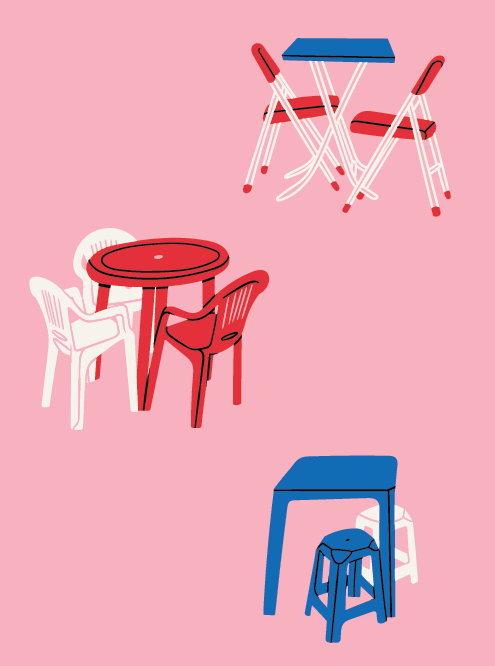
Every year at Sukkot, we build something that cannot last. A sukkah is designed to be fragile; its roof loose enough to see the stars through, its walls temporary, the whole structure meant to remind us that permanence is but an illusion. And into that fragile, temporary structure, tradition asks us to invite guests: the ushpizin, the seven symbolic visitors – Abraham, Isaac, Jacob, Moses, Aaron, Joseph, David – who join us, one each night, as we eat and pray under a roof that lets the sky in.
It's a strange practice, when you think about it. We don't build our most secure structure and then decide who's worthy of entering. We build something intentionally incomplete, intentionally flexible, and the incompleteness is what makes room for guests. The sukkah's fragility is not a flaw to be solved. It's the design.
I think about this every time we sit down with an organization to help them develop strategy and tell the story of their community, because so much of that work is really just one recurring question dressed up in different language: who is this for, and who built it?
The Argument That Sounds Right
A few parshiot – Torah portions – before Sukkot even enters the calendar, we read the story of Korach, who confronts Moses and Aaron with words that still land as strikingly modern: all the community are holy, all of them, and God is in their midst – why then do you raise yourselves above the congregation?
It's a compelling line. It's also, according to nearly the entire arc of Jewish tradition, the wrong lesson to draw from a true premise.
The rabbis don't reject Korach because he challenged power. Judaism is built on challenging power; the Talmud is essentially an argument that never resolves. They reject him because his argument, however righteous it sounded, wasn't in service of the community. It was in service of himself. Rashi reads him as motivated by resentment over who got which honor. Ibn Ezra notes that Korach wasn't an outsider clawing for a voice; he was already a person of status, unhappy with his share of it.
That distinction – between advocating for a community and advocating as a stand-in for it – is, I think, the real work of leaders in community-building. Anyone can borrow the language of inclusion. The harder question is whether the structure you're building actually redistributes anything, or whether it just adds new language to the same old room.
Designing With, Not For
As a neurodivergent, mixed-race Black Jew, I've spent most of my working life inside institutions that were not built with people like me in mind; institutions where I was told my tone was too direct, my boundaries too firm, where the norms of "professionalism" quietly encoded whose way of being counted as competent and whose didn't. That experience taught me something simple that organizations resist constantly: there's a difference between designing for a community and designing with one.
Designing for a community means you've identified a need, built a solution, and are now looking for the right messaging to bring people in. Designing with a community means the people who are supposed to benefit were in the room before the plan existed; not as feedback-givers on a finished draft, but as co-authors of the questions themselves. It's the difference between a task force that consults marginalized members of a community and a leadership table where those members already sit, with real authority, before the consulting ever needs to happen.
This is where representation gets tested. It's easy for an organization to say it represents the community it serves. It's much harder to look at who is actually in the room – whose lived experience shaped the calendar, the budget, the language on the website – and ask honestly whether those people are structurally embedded in the work or merely adjacent to it. Plenty of institutions have found a way to include difference without ever redistributing power. That's not building an inclusive structure. That's decoration.
Building the Kind of Structure That Lets People In
Which brings me back to the sukkah. Every strategy is, in a sense, a structure you're asking your community to live inside for a while. And structures reveal their values in what they assume before anyone objects: who they assumed would show up, whose needs were built into the foundation, and whose presence requires a special accommodation after the fact.
Community building, done honestly, is a spiritual practice long before it's a logistical one. It asks an organization to hold two things that don't come easily together: fidelity to what a community already is, and enough humility to keep changing shape as the community itself changes. That's a much harder task than either rigid tradition or wholesale reinvention. It's also the only version of the work that actually endures.
So as you head into your own season of story and strategy, borrow the sukkah's question rather than Korach's. Not why do you get to lead and not me, but what have we built that lets the sky in? Who did we build it with? And whose empty seat are we still waiting to fill?
The answer determines whether what you're building is a wall or a sukkah; something meant to keep people out, or something fragile enough, and honest enough, to invite them in.